Thursday, October 25, 2012

Long distance democracy

In 2008 the U.S. presidential election fell during a week I had off from classes in Rome, so I, of course, was traveling. Travel schedules and being a tourist meant that sleep was more important than staying up all night to watch the results live, so I went to bed at a normal time the day of the election. The next morning at breakfast the hostel cafeteria was buzzing with energy as people from all over the world commented on Obama's victory in all varieties of languages.

For the first time in eight years, the United States had a president that was perceived positively overseas. I noticed the change in attitude towards Americans shortly after. A couple days later I was taking a taxi in Madrid, chatting with the driver. He asked where I was from, I told him the U.S. His face lit up with a huge grin. "¡Con Obama!" he exclaimed enthusiastically. Yes, I affirmed smiling back, with Obama.

 This is my fourth time voting from overseas (2008 presidential election, 2010 midterms, 2012 primary, and now), and the third foreign address I've registered with. I guess you can say it's routine by now. I pay the price of an international stamp to mail in my ballot (0.85€ at the moment), but democracy still feels so good.
My actual ballot, which I mailed in a couple weeks ago. Naturally, I love the fact that it's in both English and Spanish. It could be because I vote from my home state of California, which has a high Spanish speaking population, but if this were nation wide I would be ecstatic. Americans voting from other states, do your ballots look like this? Are they multilingual?

Now I just need to find an election-watch party to attend. This not-so-patriotic expat just might wear red white and blue on November 6 for a change. After that, it will depend on the results.


Friday, October 19, 2012

What the NY Times didn't say

On September 24, The New York Times published a series of photos titled ¨In Spain, Austerity and Hunger¨ detailing how the economic crisis has affected Spain. Yes, the crisis is real here. I personally know people who have lost jobs, who have had to move to other countries to find work, who are struggling to make ends meet. This is the image of Spain that The New York Times has presented to America. All photo credit to Samuel Aranda for the New York Times.
A Cuban immagrant who moved to a mobile home after losing his construction job
An anti-austerity demonstration in Jaén
It´s not pretty, and it´s completely real. But it is far from the whole story of Spain, and no where near an accurate representation of what it´s like to live here. With Mitt Romney making comments that he doesn´t want the United States to end up like Spain, I ask myself, what does America really know about Spain? They don´t eat tacos and enchiladas, they are not all tan and dark haired like our image of Mexicans, and most importantly, they do not all dig in trash bins for their food. Read what the New York Times has to say, look at the pictures, because they´re all real, but then, look at this.

A Spanish news network, Antena 3, has responded. They issused a call for photos of the other side of Spain, the part that wasn´t included in the New York Times. I personally submitted several. I haven´t seen them published yet, but I´ll include them here:
 Spaniards learning about American culture. Something Americans could use a little of in reverse.
 Beautiful landscapes.
 Mouth-watering cuisine.

Spain is not a third world country. It's going through an economic crisis, but at the end of the day, Spaniards will always take care of each other. Explore other pictures that have been submitted. You will see Spain and its people, from all walks of life, in their everyday life in this beautiful country- exactly the part that American media is missing.


Friday, September 28, 2012

Pillow talk

Let’s talk pillows.

Truth: On a single bed, intended for one person to sleep, there is normally one single pillow. Exhibit A: my shared bedroom for the month I spent in Sevilla when I first came to Spain back in 2010.
Truth: On a double bed, intended for two people to sleep, there are normally two pillows. One for each person. Or two for one person who stretches out a lot. Exhibit B: My bedroom in my apartment in Málaga my first two years.
That all makes perfect sense, right? End of story? Not in Spain.

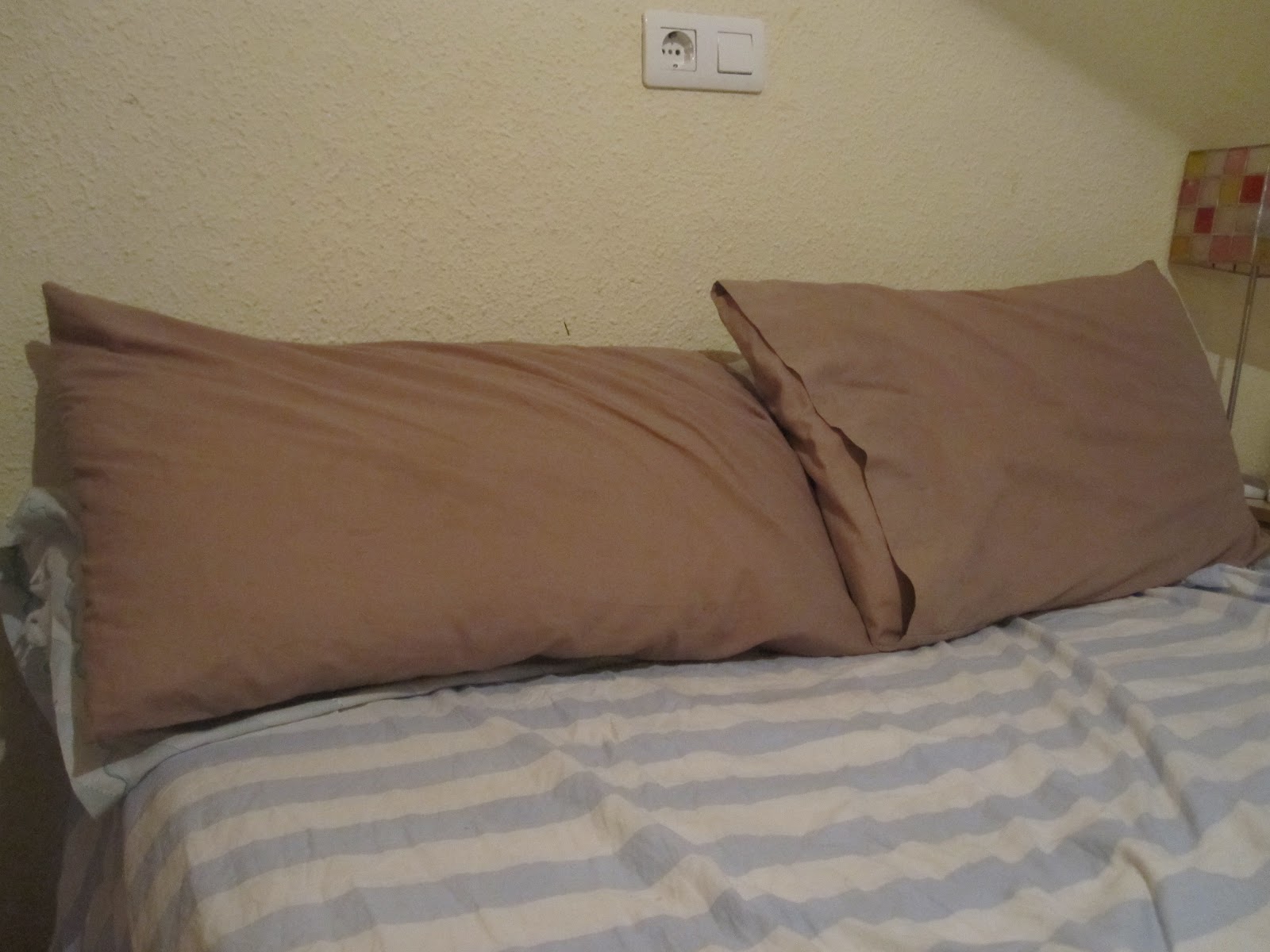
Little did I know just how abnormal my pillow situation in Málaga was for Spain. You see, here, a double bed does not mean two pillows, but rather one really long pillow. What I, and I think many others, would call a body pillow.
Using such a pillow at the head of a bed, which two people are intended to share, is something I don’t understand about Spain, and of which the Spaniard has yet to convince me. It results in an all out war over the pillow. Turning it over to the cold side, folding it in half to raise your head to read, and all other movements of the pillow, must be done in coordination. How do you do that when the other person is asleep? I can tell you it’s not exactly comfortable having a pillow pulled out from under your head.

Nevertheless, in my experience most Spaniards seem to be attached to this custom. A friend of the Spaniard’s went to Germany for a year to study. In Germany, he went shopping for a pillow for his new apartment. Much to his dismay, he couldn’t find a pillow long enough for his double bed. For months this caused him much anguish. How is one supposed to sleep with a pillow that doesn’t occupy the full width of the bed? Buy two pillows? Don’t talk nonsense. Thankfully, the poor soul came home to Spain for a short visit and was able to bring his proper, full-length pillow back to Germany, and finally he was able to sleep at night.

In our new apartment in Málaga, our landlord obviously doesn’t like to spend a lot of money. Our poor bed is deprived of the normal body pillow and instead has two of the scrappiest little excuses for pillows I’ve ever seen, and the sheet sets have two small pillowcases. This just won’t do. Luckily, the landlord’s wife had so kindly sewn the two cases together to create the more traditional long one. All we have to do is insert the two small balls of fluff, and viola! We have the typical pillow of Spain- one lovely long tube across the entire bed- but not really.
This American needs her two fluffy pillows, which in Spain means buying your own and carting them with you every time you move.

This is so worth the suitcase space.

Saturday, September 8, 2012

Technical difficulties

There´s a minor prerequisite to maintaining a blog- having internet.

The Spaniard and I moved in to the new apartment (which we love, by the way) over two weeks ago. Shortly after we evaluated options for internet, chose a company, and called to contract them. And then the waiting game began.

A week later, we´ve received a call from Telefónica saying they would come that afternoon to install the phone line. Then they called saying that because our building is so old they needed some other part they didn´t have. We´ll call you back. Famous last words.

A week later, we called. Where the hell is our internet? Umm, we´ll check in to your case and call you back. Ugh.

In the mean time, I´ve had a ton of blog ideas, I´ve missed all the speeches from both the Republican and Democratic National Conventions, and I have friends with outstanding Skype dates from at least four months ago.

I´ll be back, I promise, when my source of internet is something other than the 3G on my Kindle.

Thursday, August 16, 2012

On family, and second families

When I decided not to go home this summer I had no second thoughts. I wanted a Spanish summer. A few months ago when most other English teachers started packing bags to go home, I was overjoyed to not be participating. I smiled at the thought of not boarding planes, not sitting in tiny seats for upwards of ten hours, and not eating airline food.
Not missing this at all this summer
Fast forward to two days ago and I was on the verge of buying a plane ticket home. I love Spain, but I also love my family, and I needed to see them. I've lived here for two years, but going home both years for Christmas and last summer means I've never spent more than six months away from home. Now I'm going on eight. I think I have some sort of internal clock, and its alarm was going off telling me to go home and recharge my batteries. I only wanted to visit for a week or two. My heart and soul are here in Andalucía, but there comes a point when Skype conversations just aren't enough to satisfy the need for family. I want to hug my dad. I want to play soccer with my brothers. I want to go out to lunch with my mom and exchange stories about our students. And I really want to walk my dog.
Sad because I'm gone, or just pretending to be an alligator
But I slept on it. I mulled over the idea, and in the end my reasons for not going, for staying here, go beyond just the price tag. This month I have a roof over my head thanks to the Spaniard's family. From day one with him, his family has been nothing but wonderful. They have accepted me with open arms. I have family here in Spain. I have his parents, sister, and countless cousins, aunts, and uncles. (We tallied the other day and I've now met all of his cousins except one). I might not be blood-related to anyone here, but I definitely have family. Running home now, I feel, would be unappreciative of everything they've done for me. Instead, I'm going to stay here, and I'm going to bake a birthday cake for my suegra (mother-in-law).

As for my own family, I'll see them at Christmas. That flight, I already have booked.

Sunday, August 12, 2012

Why hello there

It's been a while (again). Oops. You see, since I wrote last, my mom came to visit (!). She met the Spaniard and his family, and we spent two weeks hopping around between Madrid, Granada, Málaga, Sevilla, Ronda, and Nerja.
Exploring pueblos in the mountains of Alpujarra
A visit to the Alhambra, of course
Then I spent the entire month of July working (quite literally). Part English teacher, part camp counselor, part baby-sitter. Working a summer camp was quite an experience, and I think we'll leave it at that.

Now the Spaniard and I are back in Granada, trying to find anything to escape the heat. We've had minimal success in the matter hiking at night, and calling anyone and everyone we know here who has a swimming pool.

What's in store for the next chapter? Moving back to Málaga in two weeks, taking the Spaniard with me (for good!), and both of us starting new jobs. We already have a little love-nest rented right smack in the city center. Stay tuned for the adventures of a Granadino and an Americana in Málaga. I'm sure it won't be boring.


Monday, June 18, 2012

The revelation

Remember back when I talked about that little secret I kept from my students? They didn´t know that I speak Spanish. It was great in that it forced them to use English any way they could to communicate with me. It´s negative side was that many were shy, afraid to make mistakes, and therefore seemingly afraid of me.

I spent the entire year pretending not to understand the chitter chatter between my students, trying not to laugh when someone said something stupid/funny, and scanning the hallways for students when ever I would chat with other teachers in Spanish. It wasn´t easy, I´ll admit, and there were plenty of times I just wanted to be understood, more for the sake of classroom management than anything.

But a couple weeks ago the last day of my contract rolled around. The kids knew it was my last day, and we were saying goodbyes and thank yous. My coworker said to the class ´´Hey! You guys know that Amy has spoken perfect Spanish all year?´´ (Her words, not mine. My Spanish is far from perfect.)

A resounding ´´¿Qué?´´ echoed through the room. Jaws dropped. Then the chatter and the questions started. Many of course bragged ´´I knew that she spoke Spanish. Remember that one time I asked her to translate a word to English and she knew it?´´ Because of course knowing one word means speaking a language.

Students who have barely spoken two words to me all year outside of obligatory class activities all of a sudden wanted to talk to me, tell me thank you, and give me hugs goodbye.

For some, it was like I was a whole new person. They asked what my favorite Spanish foods are, if I´ve ever tried gazpacho, and if I´ve ever visited their parents´ pueblos. Because the idea the I also live in Spain and don´t just magically show up at school everyday hadn´t occurred to them before knowing that I speak the language.

One particularly savvy eleven year-old started quizzing me. He asked some basic classroom vocabulary, was pleased with my response, and then came the real test. ´´¿Cómo es el verbo ´andar´ en el pasado?´´ The past tense of the verb andar, one that many Spaniards don´t realize is irregular. ´´Anduve, anduviste, anduvo...´´ I began with a smile. ´´¡Whoooaa!´´ he and his classmates exclaimed in pleasant surprise.

This process continued throughout all of my classes. I spoke to each one in Spanish, thanking them for a memorable year teaching them, and urging them to continue studying languages. I explained to them how lucky they are to have started learning English so young, that most schools in the U.S. don´t begin with languages until high school. I told them that they know more English than almost any American of their age knows of any other language, and that they should take advantage of the opportunity. I told them that at their age I hadn´t even started studying Spanish, and that now I speak it well enough to live in Spain. Imagine where they could be if they keep studying.

All of the frustrating moments all year were well worth the final result, and without hesitation I would urge all auxiliars that if you can, don´t speak anything but English in the classroom. It will be a worthwhile experience for you and your students.